|
|
|
Todea A.; Stuparu, D.G. & Todea, A.M. (2026) Finance Research Letters [Core Economics, Q1]
Autor:
Cristina Alexandrina Stefanescu
Publicat:
20 Aprilie 2026
Todea A.; Stuparu, D.G. & Todea, A.M. (2026) Cultural secrecy, corruption, and earnings management. Finance Research Letters, 100, 109986.
DOI: https://doi.org/10.1016/j.frl.2026.109986
✓ Publisher: Elsevier
✓ Categories: Business, Finance
✓ Article Influence Score (AIS): 1.004 (2025) / Q1
Abstract:
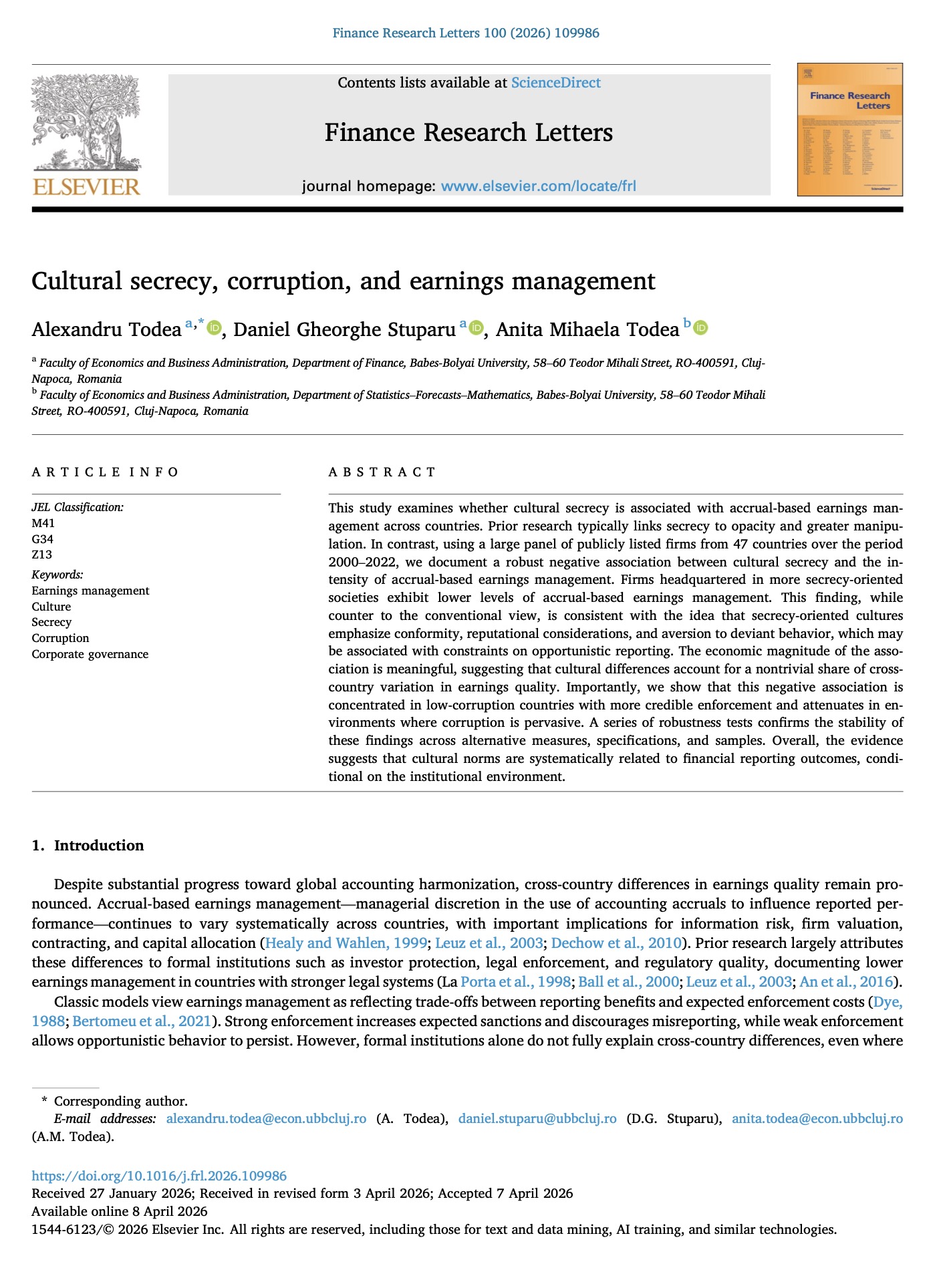
This study examines whether cultural secrecy is associated with accrual-based earnings management across countries. Prior research typically links secrecy to opacity and greater manipulation. In contrast, using a large panel of publicly listed firms from 47 countries over the period 2000–2022, we document a robust negative association between cultural secrecy and the intensity of accrual-based earnings management. Firms headquartered in more secrecy-oriented societies exhibit lower levels of accrual-based earnings management. This finding, while counter to the conventional view, is consistent with the idea that secrecy-oriented cultures emphasize conformity, reputational considerations, and aversion to deviant behavior, which may be associated with constraints on opportunistic reporting. The economic magnitude of the association is meaningful, suggesting that cultural differences account for a nontrivial share of cross-country variation in earnings quality. Importantly, we show that this negative association is concentrated in low-corruption countries with more credible enforcement and attenuates in environments where corruption is pervasive. A series of robustness tests confirms the stability of these findings across alternative measures, specifications, and samples. Overall, the evidence suggests that cultural norms are systematically related to financial reporting outcomes, conditional on the institutional environment.
inapoi la stiri  vezi evenimentele
home
vezi evenimentele
home
|