Popa M. (2026) International Journal of Management Education [Domenii Conexe Q1; Core Economics, Q2]
Autor:
Cristina Alexandrina Stefanescu
Publicat:
26 Aprilie 2026
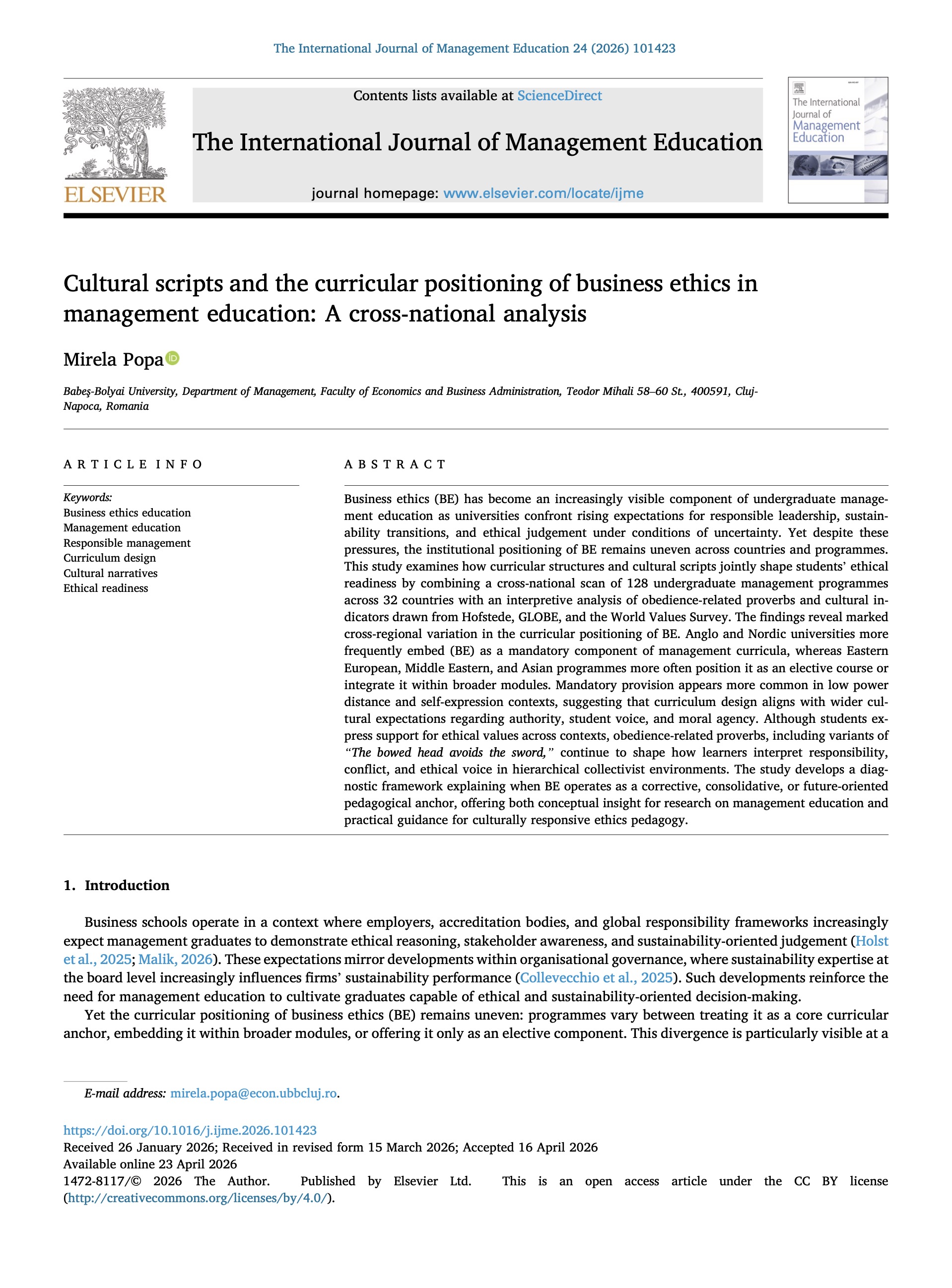
Popa M. (2026) Cultural scripts and the curricular positioning of business ethics in management education: A cross-national analysis. International Journal of Management Education, 24(3), 101423.
DOI: https://doi.org/10.1016/j.ijme.2026.101423
✓ Publisher: Elsevier
✓ Categories: Business; Management; Education & Educational Research
✓ Article Influence Score (AIS): 0.966 (2025) / Q1 in Education & Educational Research; Q2 in Business; Management.
Abstract:
Business ethics (BE) has become an increasingly visible component of undergraduate management education as universities confront rising expectations for responsible leadership, sustainability transitions, and ethical judgement under conditions of uncertainty. Yet despite these pressures, the institutional positioning of BE remains uneven across countries and programmes. This study examines how curricular structures and cultural scripts jointly shape students’ ethical readiness by combining a cross-national scan of 128 undergraduate management programmes across 32 countries with an interpretive analysis of obedience-related proverbs and cultural indicators drawn from Hofstede, GLOBE, and the World Values Survey. The findings reveal marked cross-regional variation in the curricular positioning of BE. Anglo and Nordic universities more frequently embed (BE) as a mandatory component of management curricula, whereas Eastern European, Middle Eastern, and Asian programmes more often position it as an elective course or integrate it within broader modules. Mandatory provision appears more common in low power distance and self-expression contexts, suggesting that curriculum design aligns with wider cultural expectations regarding authority, student voice, and moral agency. Although students express support for ethical values across contexts, obedience-related proverbs, including variants of “The bowed head avoids the sword,” continue to shape how learners interpret responsibility, conflict, and ethical voice in hierarchical collectivist environments. The study develops a diagnostic framework explaining when BE operates as a corrective, consolidative, or future-oriented pedagogical anchor, offering both conceptual insight for research on management education and practical guidance for culturally responsive ethics pedagogy.
inapoi la stiri  vezi evenimentele
home
vezi evenimentele
home